
Before you start
Plan a manageable session with one focus, a short review and a written next step your team can revisit.
- Willing teammates, an agreed game/platform and a realistic shared time window.
- A permitted practice mode and a way to take notes; recording needs participants' consent.
- Current game/client access for feature checks. The example below uses VALORANT; adapt drills to your game.
Introduction
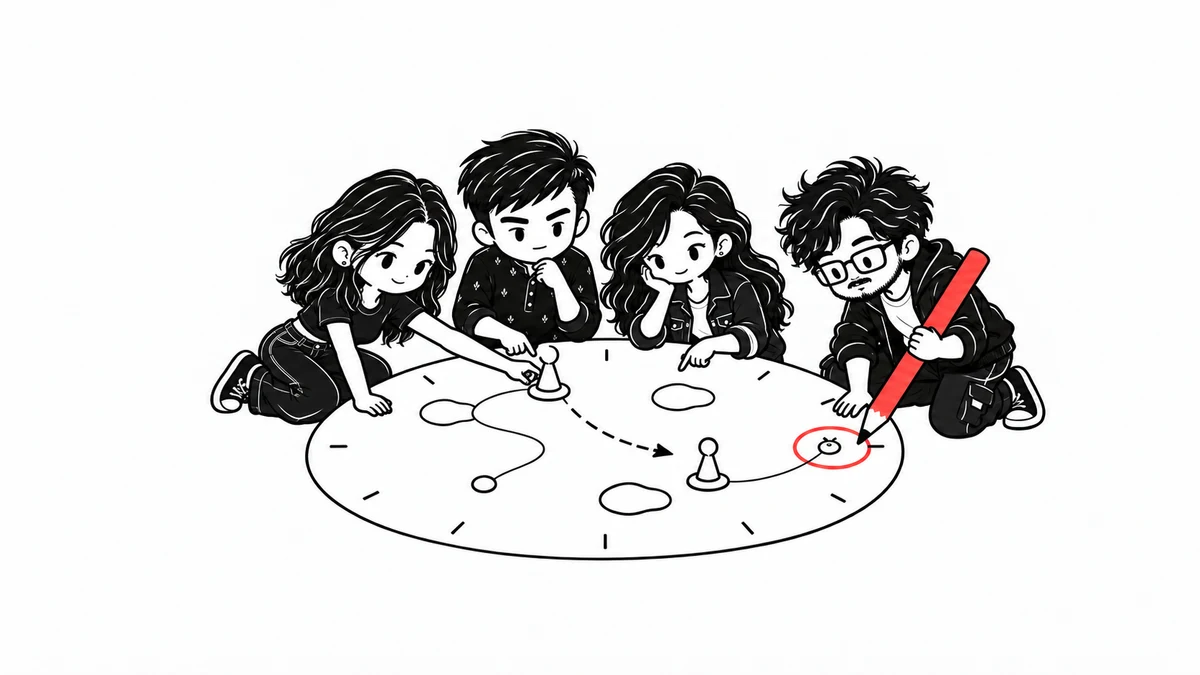
Choose one problem the team recognizes. For a beginner VALORANT group, that might be announcing when a teammate needs a trade, or naming who watches a route. The routine below is an editorial suggestion with illustrative durations. It has not been tested with a team and carries no promise of rank or win-rate improvement.
1. Agree the session before starting
Ask when each person can arrive and must leave. State the single focus and who will keep notes. If the group cannot stay for a full match, choose a shorter practice activity rather than starting a match someone will need to abandon. Do not count another person's availability as consent to record their voice.
2. Define the call you want to practise
Write one observable behavior. Example: after seeing an opponent, name the location and number seen before discussing what happened. Agree the location words and who makes the next decision. Choose roles for this session, not permanent labels for players. Keep criticism about the decision or communication, with room for a teammate to explain what they saw.
3. Use a small session plan
The following 60-minute block is a planning example, not a required match length. Adjust it to your group. The 20-minute practice block fits a drill or agreed short activity; it does not promise that a full VALORANT match will finish in that window. Reserve more time or choose a different activity when a full match is the goal.
Illustrative 60-minute session; no results recorded
| Minutes | Activity | What to note |
|---|---|---|
| 0–5 | Agree focus and roles | One behavior to watch |
| 5–15 | Individual warm-up | Comfort with controls |
| 15–35 | Focused team drill or short activity | One example of the agreed call |
| 35–40 | Break | Whether to continue |
| 40–55 | Review one situation | What each player knew |
| 55–60 | Choose the next action | One change for next session |
4. Practise a decision you can describe
For a VALORANT example, walk through one route in a permitted custom mode and agree when the second player can respond to the first player's information. Keep the drill small enough to repeat. Check the current client options and rules before relying on a feature. If an opponent or full team is unavailable, practise the communication sequence and label it a walkthrough rather than a scrim.
5. Review one situation with evidence
Use a replay if the mode and current client support it, or write notes immediately after the situation. Riot's 12.10 patch notes say custom-game replay recording must be enabled by the lobby owner before each new game.1 Confirm that option before a planned review and get recording consent. This is a documented feature, not a client test conducted during preparation.
Pause on one decision. Ask what information was visible, which call was made, and what a teammate could reasonably do next. Avoid turning a single round into a judgment about the player. If the recording is missing, review notes with that limitation instead of reconstructing precise timings from memory.
6. Keep a short private log
Record the actual date, game build, focus, consenting participants, session length, one observed obstacle and one action for next time. Leave results blank until a session has happened. Recordings and handles stay private unless their owners agree to sharing. A small note that changes the next session is enough; a public scorecard is unnecessary.
Blank session log
Date / timezone:
Game / build / mode:
Consent and recording choice:
Planned focus:
Actual duration:
Observed situation:
What the team agreed to change:
Next session question:
7. Adjust to what actually happened
If arrivals consumed the session, shorten setup next time. If calls overlapped, agree who leads the next drill. If someone is tired or uncomfortable, pause or end the session. Change one part of the plan before comparing sessions. A win does not prove the routine worked, and a loss does not by itself show that the agreed behavior failed.
- Missing replay: check mode support and the pre-game recording option; use notes if evidence is unavailable.
- Nobody shares the same free hour: agree a shorter activity that fits rather than assigning attendance by assumption.
- Review turns into blame: return to what was known at the decision point and let each person speak.
- A tournament is next: read its actual rules and timing with the related entry checklist.
For another game, replace the mode, roles and drill with that game's official options. Keep the session log and one-focus approach as suggestions, and test whether they fit your team. No coached session, participant feedback or competitive outcome is claimed here.
Troubleshooting
Use the symptom checks above. Record the exact version and first relevant error before changing another setting.
Sources & evidence
AI-assisted guide prepared for INFIRALS. Untested editorial practice suggestion. VALORANT is the documentation example; owner game/team choice and consent are pending. No session, client feature, replay playback, participant feedback or effectiveness result was tested.
- VALORANT Patch Notes 12.10 (Riot Games)
- Premier: Team Creation & Management (Riot Games)